Thyronorm
Thyronorm (Levothyroxine Sodium) tablets are for thyroid hormone replacement in all age groups. Its ingredient, oral levothyroxine sodium, is a synthetic 14-hormone that exerts the same physiologic effect as endogenous T4, thereby maintaining normal 14 levels when a deficiency is present.
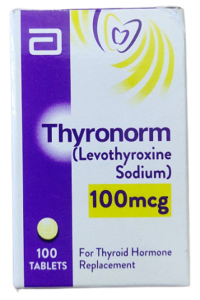
Package contains: Each package contains 100mcg tablets in a glass bottle & enclosed leaf. It is also available in 25mcg, 50mcg, 75mcg & 125mcg tablets.
Composition:
Each tablet contains:
Levothyroxine Sodium Ph. Eur.
Equivalent to anhydrous levothyroxine Sodium 100 mg.
Dosage: As directed by the physician.
Indications & Usage:
Hypothyroidism: THYRONORM is indicated in adult and pediatric patients, including neonates, as a replacement therapy in primary (thyroidal), secondary (pituitary), and tertiary (hypothalamic) congenital or acquired hypothyroidism.
Pituitary Thyrotropin (Thyroid-Stimulating Hormone, TSH) Suppression: It is indicated in adult and pediatric patients, including neonates, as an adjunct to surgery and radioiodine therapy in the management of thyrotropin-dependent well-differentiated thyroid cancer.
Limitations of Use: It is not indicated for the suppression of benign thyroid nodules and nontoxic diffuse goiter in iodine-sufficient patients, as there are no clinical benefits and overtreatment with THYRONORM may induce hyperthyroidism.
THYRONORM is not indicated for the treatment of hypothyroidism during the recovery phase of subacute thyroiditis.
Dosing and Administration: As directed by a physician. It is administered as a single daily dose. Preferably one-half hour before breakfast. Thyronorm dosage depends on body weight, age, and medical conditions. It should be taken at least 4 hours apart from drugs that are known to interfere with its absorption (e.g., synthesis, protein binding, and secretion).
Instruct patients to notify their healthcare provider if they are pregnant or breastfeeding or are thinking of becoming pregnant while taking THYRONORM.
WARNING: Not for treatment of obesity or for weight loss: Thyroid hormones, including THYRONORM, either alone or with other therapeutic agents, should not be used for the treatment of obesity or for weight loss.
In euthyroid patients, doses within the range of daily hormonal requirements are ineffective for weight reduction.
Larger doses may produce serious or even life-threatening manifestations of toxicity, particularly when given in association with sympathomimetic amines such as those used for their anorectic effects.
Important Information:
- Inform patients that it may take several weeks before they notice an improvement in symptoms.
- Inform patients that the levothyroxine in THYRONORM is intended to replace a hormone that is normally produced by the thyroid gland. Generally, replacement therapy is to be taken for life.
- Inform patients that THYRONORM should not be used as a primary or adjunctive therapy in a weight control program.
- Instruct patients to notify their healthcare provider if they are taking any other medications, including prescription and over-the-counter preparations.
- Instruct patients to notify their physician of any other medical conditions they may have, particularly heart disease, diabetes, clotting disorders, and adrenal or pituitary gland problems, as the dose of medications used to control these other conditions may need to be adjusted while they are taking THYRONORM, If they have diabetes, instruct patients to monitor their blood and/or urinary glucose levels as directed by their physician and immediately report any changes to their physician. If patients are taking anticoagulants, their clotting status should be checked frequently.
- Instruct patients to notify their physician or dentist that they are taking THYRONORM prior to any surgery.
Adverse Reactions/ Side Effects: Adverse reactions associated with THYRONORM therapy are primarily those of hyperthyroidism due to therapeutic overdosage, and these include the following:
- General: fatigue, increased appetite, weight loss, heat intolerance, fever, excessive sweating.
- Central nervous system: headache, hyperactivity, nervousness, anxiety, irritability, emotional liability, insomnia.
- Musculoskeletal: tremors, muscle weakness, muscle spasm.
- Cardiovascular: palpitations, tachycardia, arrhythmias, increased pulse and blood pressure, heart failure, angina, myocardial infarction, cardiac arrest.
- Respiratory: dyspnea.
- Gastrointestinal: diarrhea, vomiting, abdominal cramps, and elevations in liver function tests.
- Dermatologic: hair loss, flushing, rash.
- Endocrine: decreased bone mineral density.
- Reproductive: menstrual irregularities, impaired fertility.
- Seizures have been reported rarely with the institution of levothyroxine therapy.
Instruct patients to notify their healthcare provider if they experience any of the following symptoms: rapid or irregular heartbeat, chest pain, shortness of breath, leg cramps, headache, nervousness, irritability, sleeplessness, tremors, change in appetite, weight gain or loss, vomiting, diarrhea, excessive sweating, heat intolerance, fever, changes in menstrual periods, hives or skin rash, or any other unusual medical event.
Inform patients that partial hair loss may occur rarely during the first few months of THYRONORM therapy, but this is usually temporary.
Hypersensitivity Reactions: Hypersensitivity reactions to inactive ingredients have occurred in patients treated with thyroid hormone products. These include urticaria, pruritus, skin rash, flushing, angioedema, various gastrointestinal symptoms (abdominal pain, nausea, vomiting, and diarrhea), fever, arthralgia, serum sickness, and wheezing. Hypersensitivity to levothyroxine itself is not known to occur.
Pregnancy: There are risks to the mother and fetus associated with untreated hypothyroidism in pregnancy. Since TSH levels may increase during pregnancy, TSH should be monitored and THYRONORM dosage adjusted during pregnancy. Animal reproductive studies have not been conducted with levothyroxine sodium. THYRONORM should not be discontinued during pregnancy, and hypothyroidism diagnosed during pregnancy should be promptly treated.
Summary:
- Untreated hypothyroidism during pregnancy is risky.
- THYRONORM (levothyroxine) should not be stopped during pregnancy.
- TSH levels should be monitored and the dose adjusted as needed.
- Available human data show no increased risk of birth defects or miscarriage with proper treatment.
- Treating hypothyroidism helps protect both mother and baby.
Lactation: Published studies report that levothyroxine is present in human milk following the administration of oral levothyroxine. No adverse effects on the breastfed infant have been reported, and there is no information on the effects of levothyroxine on milk production. Adequate levothyroxine treatment during lactation may normalize milk production in hypothyroid lactating mothers with low milk supply. The developmental and health benefits of breastfeeding should be considered along with the mother’s clinical need for THYRONORM and any potential adverse effects on the breastfed infant from THYRONORM or from the underlying maternal condition.
Warnings & Precautions: Serious Risks Related to Overtreatment or Undertreatment with THYRONORM:
It has a narrow therapeutic index. Over-treatment or undertreatment with THYRONORM may have negative effects on growth and development, cardiovascular function, bone metabolism, reproductive function, cognitive function, gastrointestinal function, and glucose and lipid metabolism in adult or pediatric patients.
In pediatric patients with congenital and acquired hypothyroidism, undertreatment may adversely affect cognitive development and linear growth, and overtreatment is associated with craniosynostosis and acceleration of bone age.
Titrate the dose of THYRONORM carefully and monitor response. Consider the potential for food or drug interactions and adjust the administration or dosage of THYRONORM as needed.
Instruction: Do not store above 30°C. 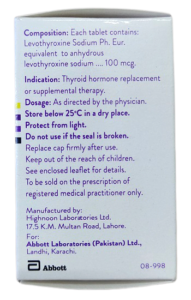
Protect from light and moisture.
Do not use if the seal is broken.
Replace the cap firmly after use.
Keep out of the reach of children.
See enclosed leaflet for details.
To be sold on the prescription of registered medical practitioner only.
Manufacturer & Buy Online:
Thyronorm tablets are manufactured by: Highnoon Laboratories Ltd.
This is the link to the manufacturer: https://highnoon
It is manufactured for: Abbott Laboratories (Pakistan).
This is the link to the manufactured for company: https://www.pk.abbott
You can buy it online at: https://www.dvago.pk
You can also buy it from a nearby pharmacy.