
Anplag
Anplag (TICAGRELOR BP) by PharmEvo contains 20 tablets of 90 mg. It is a blood thinner/antiplatelet medicine, mainly used to prevent blood clots after a heart attack.
Package Contains: Each Anplag package contains 20 tablets of 90 mg & a leaflet. It is also available in 60mg tablets.
Composition: 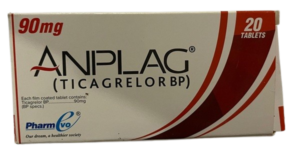
Each film – coated tablet contains:
TICAGRELOR BP 90 mg
(BP specs.)
Dosage: As advised by the Physician.
Indications / Uses: Anplag tablets are indicated to reduce the rate of;
- Cardiovascular death
- Myocardial infarction
- (MI) Stroke in patients with acute coronary syndrome (ACS) or a history of myocardial infarction
- Also reduces the rate of stent thrombosis in patients who have been stented for treatment of ACS.
Dosage & Administration:
Adult dosage: In the management of ACS, initiate Ticagrelor treatment with a 180 mg loading dose. Administer 90 mg twice daily during the first year after an ACS event. After one year administer 60 mg twice daily.
Do not administer Ticagrelor with another oral P2Y12 platelet inhibitor. Use Ticagrelor with a daily maintenance dose of aspirin of 75-100 mg. A patient who misses a dose of Tiengrelor should take one tablet (their next dose) at its scheduled time.
Administration requirements: For patients who are unable to swallow tablets whole, Ticagrelor tablets can be crushed, mixed with water and drunk. The mixture is administered via a nasogastric tube (CH8 or greater).
Contraindications:
History of Intracranial Hemorrhage: Ticagrelor is contraindicated in patients with a history of intracranial hemorrhage (ICH) because of a high risk of recurrent ICH in this population.
Active Bleeding: Ticagrelor is contraindicated in patients with active pathological bleeding such as peptic ulcer or intracranial hemorrhage.
Hypersensitivity: Ticagrelor is contraindicated in patients with hypersensitivity (e.g., angioedema) to ticagrelor or any component of the product.
Severe Hepatic Impairment: Ticagrelor is contraindicated in patients with severe hepatic patients because of probable increased exposure. Severe hepatic impairment increases the risk of bleeding because of reduced synthesis of coagulation proteins.
Adverse Reactions:
- Neoplasms benign, malignant and unspecified (including cysts and polyps):
- Uncommon: Tumor bleeding, Blood and lymphatic system disorders:
- Very common: Blood disorder bleeding.
Immune system disorders:
- Uncommon: Hypersensitivity, including angioedema
- Metabolism and nutrition disorders:
- Very common: Hyperuricaemia.
- Common: Gout/Gouty Arthritis
- Psychiatric disorders: Uncommon: Confusion.
Nervous system disorders
- Common: Dizziness, Syncope, headache.
- Uncommon: Intracranial haemorrhage (m) i.e. spontaneous, procedure-related, or traumatic intracranial haemorrhage
Eye disorders
- Uncommon: Eye haemorrhage
- Ear and labyrinth disorders Common: Vertigo
- Uncommon: Ear haemorrhage
- Vascular disorders Common: Hypotension
- Respiratory, thoracic and mediastinal disorders: Very common: Dyspnoea
- Common: Respiratory system bleeding.
Gastrointestinal disorders
- Common: Gastrointestinal haemorrhage, Diarrhoea, Nausea, Dyspepsia, Constipation Uncommon: Retroperitoneal haemorrhage, Skin and subcutaneous tissue disorders.
- Common: Subcutaneous or dermal bleeding, Rash, pruritus. Musculoskeletal connective tissue and bone.
- Uncommon: Muscular bleedings Renal and urinary disorders
- Common: Urinary tract bleeding Reproductive system and breast disorders.
- Uncommon: Reproductive system bleedings Lab investigations.
- Common: Blood creatinine increased
- Injury, poisoning and procedural complications
Common: Post-procedural haemorrhage, traumatic bleeding
- g. bleeding from bladder cancer, gastric cancer, colon cancer
- g. increased tendency to bruise, spontaneous haematoma, haemorrhagic diathesis
- g. Identified in post-marketing experience
- e g. Frequencies derived from lab observations (Uric acid increases to upper limit of normal from baseline below or within reference Creatinine increases of >50% from baseline.) and not crude adverse event report frequency.
- *e.g. conjunctival, retinal, intraocular
- g. gingival bleeding, rectal haemorrhage, gastric ulcer haemorrhage.
- g. epistaxis, haemoptysis.
- g. ecchymosis, skin haemorrhage, petechiae
- g. haemarthrosis, muscle haemorrhage e.g. haematuria, cystitis haemorrhagic
- *e.g. vaginal haemorrhage, haematospermia, postmenopausal
- g. contusion, traumatic haematoma, traumatic haemorrhage.
Use in Special Populations:
Pregnancy: US FDA Pregnancy Category C. There are no grade C. There are no adequate and well-controlled studies of ticagrelor in many women. In animal studies, ticagrelor caused structural abnormalities at maternal use in height 5 to 7 times the maximum recommended human dose (MRHD) based on body Ticagrelor should be used during pregnancy only if the potential benefit justifies the surface area Tricare fetus potential risk 101 doses.
Nursing mothers: It is not known whether ticagrelor or its active metabolites are excreted in human milk. Because y drugs are excreted in human milk, and because of the potential for serious adverse jobs in nursing infants from Ticagrelor, a decision should be made whether to discontinue nursing or to discontinue Ticagrelor.
Pediatrics: The safety and effectiveness of Ticagrelor in pediatric patients have not been established.
Elderly: No overall differences in safety or effectiveness are observed between elderly and younger patients.
Warning & Precautions:
General Risk of Bleeding: Drugs that inhibit platelet function, including Ticagrelor, increase the risk of bleeding. If possible, manage bleeding without discontinuing Ticagrelor. Stopping Ticagrelor increases the risk of subsequent cardiovascular events.
Concomitant Aspirin Maintenance Dose: The use of Ticagrelor with maintenance doses of aspirin above 100 mg decreased the effectiveness of Ticagrelor. Therefore, after the initial loading dose of aspirin, use Ticagrelor with a maintenance dose of aspirin of 75-100 mg.
Effects on ability to drive and use machines: While Ticagrelor has no or negligible influence on the ability to drive and therefore, patients who treat with ticagrelor, dizziness and confusion have been reported experiencing these symptoms should be cautious while driving or using machines.
For more information, please see the leaflet.
Instructions: 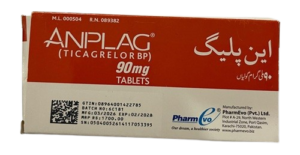
Keep all medicines out of the reach of children.
Protect from light, heat and moisture.
Store below 30°C.
For details, please see enclosed leaf insert.
To be sold on the prescription of a registered medical practitioner only.
Note: For suspected adverse drug reactions, report at reports@pharmevo.biz
Manufacturer & Buy Online:
Anplag tablets are manufactured by: PharmEvo ( Pvt.) Ltd.
This is the link to the manufacturer: https://pharmevo.biz
You can buy it online at: https://dwatson.pk
Or you can purchase it from any nearby pharmacy. It is currently ( 2026 ) available at the retail price of around 1700 rupees.
By: Munee