Co-Travost
Co-Travost Travoprost/Timolol 0.004% w/v/0.5% w/v eye drops is a sterile ophthalmic solution of 2.5ml. It contains travoprost, a prostaglandin analogue that helps lower eye pressure by increasing the drainage of fluid from the eye.
Timolol, a non-selective beta-adrenergic receptor blocking agent (beta-blocker) and Polyquaternium-1 (as preservative). It lowers eye pressure by reducing the amount of fluid the eye produces.
Package contains: Each Co-Travost package contains eye drops in a 2.5ml plastic dropper bottle & a leaflet.
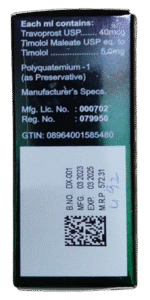
Composition: Each ml contains: 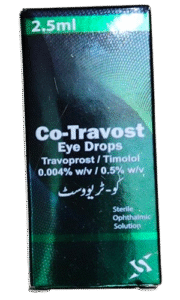
Travoprost USP 40mcg
Timolol Maleate USP eq. to Timolol 5.0mg
Polyquaternium-1 (as Preservative)
Manufacturer’s Specs.
Dosage: As directed by the physician.
Indication: Co-Travost sterile ophthalmic solution is indicated for the decrease of intraocular pressure (IOP) in adult patients with open-angle glaucoma or ocular hypertension who are insufficiently responsive to topical beta blockers or prostaglandin analogues.
Dosage & Administration: The recommended dosage of Co-Travost is one drop in the conjunctival sac of the affected eye(s) once daily, in the morning or evening. It should be administered at the same time each day.
The dosage of the eye drops should not exceed one drop in the affected eye(s) once daily, since it has been shown that more frequent administration of prostaglandin analogues may decrease the IOP-lowering effect.
If a dose is missed, treatment should be continued with the next dose as normal. If more than one topical ophthalmic drug is being used, the drugs should be administered at least 5 minutes apart.
When substituting another ophthalmic antiglaucoma medicinal product with Co-Travost eye drops, the other medicinal product should be discontinued, and Co-Travost eye drops should be started the following day.
Pediatric Patients (Below 18 years): The use of Co-Travost eye drops in pediatric patients is currently not recommended. The safety and efficacy of the use of the eye drops in children and adolescents below the age of 18 years have not been established. No data is available.
Geriatric Patients (65 years of age and above): No overall differences in safety or effectiveness have been observed between elderly and other adult patients.
Contra-indications:
- Hypersensitivity to the active substances or to any of the excipients.
- Reactive airway disease, including bronchial asthma or a history of bronchial asthma, or severe chronic obstructive pulmonary disease.
- Sinus bradycardia, sick sinus syndrome (Including Sino-atrial block), second or third-degree atrioventricular block, overt cardiac failure, or cardiogenic shock.
Warnings & Precautions: General: Like other topically applied ophthalmic agents, Travest and Timolol, the same types of cardiovascular, pulmonary and other adverse reactions seen with systemic beta-adrenergic blocking agents may occur.
Cardiac Disorders: Rarely, deaths in association with cardiac failure have been reported following systemic or ophthalmic administration of Timolol maleate. In patients with cardiovascular diseases (e.g., coronary heart disease, Prinzmetal’s angina and cardiac failure) and hypotension, therapy with beta blockers should be critically assessed, and therapy with other active substances should be considered. Patients with cardiovascular diseases should be watched for signs of deterioration of these diseases and for adverse reactions.
Vascular Disorders: Patients with severe peripheral circulatory disturbance/disorders (ie, severe forms of Raynaud’s disease or Raynaud’s syndrome) should be treated with caution.
Respiratory Disorders: Respiratory reactions, including death due to bronchospasm in patients with asthma have been reported following administration of some ophthalmic beta-blockers.
Hypoglycaemia/ Diabetes: Beta-blockers should be administered with caution in patients subject to spontaneous hypoglycemia or to patients with labile diabetes who are receiving insulin or oral hypoglycaemic agents, as beta-blockers may mask the signs and symptoms of acute hypoglycaemia.
Hyperthyroidism: Beta-blockers may mask the signs of hyperthyroidism.
Muscle Weakness: Beta-adrenergic blocking agents have been reported to potentiate muscle weakness consistent with certain myasthenic symptoms (eg, diplopia, ptosis and generalized weakness).
Skin Contact: Prostaglandins and prostaglandin analogues are biologically active substances that may be absorbed through the skin. Women who are pregnant or attempting to become pregnant should exercise appropriate precautions to avoid direct exposure to the contents of the bottle. In the unlikely event of coming in contact with a substantial portion of the contents of the bottle, thoroughly cleanse the exposed area immediately.
Anaphylactic Reactions: While taking beta-blockers, patients with a history of atopy or a history of severe anaphylactic reaction to a variety of allergens may be more reactive to repeated challenge with such allergens and unresponsive to the usual dose of adrenaline (epinephrine) used to treat anaphylactic reactions.
Ocular Effects: Travoprost may gradually change the eye colour by increasing the number of melanosomes (pigment granules) in melanocytes. Before treatment is instituted, patients must be informed of the possibility of a permanent change in eye colour. The change in iris color occurs slowly and may not be noticeable for months to years.
Choroidal Detachment: Choroidal detachment has been reported with the administration of aqueous suppressant therapy (eg. Timolol, acetazolamide) after filtration procedures.
Surgical Anesthesia: Beta-blocking ophthalmological preparations may block systemic beta-agonist effects, e.g. of adrenaline. The anaesthesiologist should be informed when the patient is receiving Timolol.
Other Beta-blocking Agents: The effect on intra-ocular pressure or the known effects of systemic beta-blockade may be exaggerated when Timolol is given to the patients already receiving a systemic beta-blocking agent. The response of these patients should be closely observed. The use of two Topical beta-adrenergic blocking agents is not recommended.
Pregnancy & Lactation: Co-Travost eye drop should not be used during pregnancy unless clearly necessary. However, if Co-Travost eye drop is administered during pregnancy up to the time of delivery, the neonate should be carefully monitored. There is a limited amount of data from the use of a combination eye drop (Travoprost /Timolol) or the individual components in pregnant women.
Timolol is transferred into human breast milk following ocular topical administration. It is unknown whether Travoprost is transferred into human breast milk after ocular administration.
Note / Instructions: For full prescribing information, see package insert. Do not store above 30°C. Protect from light Keep out of reach of children. Use within one month after opening. To be sold on prescription of registered medical practitioner only.
Manufacturer & Buy Online:
Co-Travost eye drops are manufactured by Sante (Private) Limited.
This is the link to the manufacturer: https://www.sante
You can buy it online at: https://www.naheed.pk
You can also buy it from any nearby pharmacy.