Tacrus
Tacrus (Tacrolimus 0.1% w/w) by MAXITECH is an Ointment of 10gm. It is for external use only & used for atopic dermatitis.
Package contains: Each pack of Tacrus contains an ointment tube of 10 gram & a leaflet.
Composition: Each gram contains: 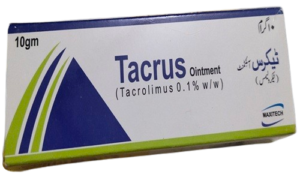
Tacrolimus (as monohydrate) 1mg.
(Product Specs. As per Innovator’s Specs.)
Application: As directed by the physician or see package insert for full prescribing information.
Uses / Indication: Flare treatment: Adults and adolescents (16 years of age and above): Treatment of moderate to severe atopic dermatitis in adults who are not adequately responsive to or are intolerant of conventional therapies such as topical corticosteroids.
Maintenance treatment: Treatment of moderate to severe atopic dermatitis for the prevention of flares and the prolongation of flare-free intervals in patients experiencing a high frequency of disease exacerbations (ie, occurring 4 or more times per year) who have had an initial response to a maximum of 6 weeks treatment of twice daily Tacrolimus ointment (lesions cleared, almost cleared or mildly affected).
Method of Administration: Flare treatment: It can be used for short-term and intermittent long-term treatment. Treatment should not be continuous on a long-term basis. Tacrus treatment should begin at the first appearance of signs and symptoms. Each affected region of the skin should be treated with Tacrus until lesions are cleared, almost cleared or mildly affected. Thereafter, patients are considered suitable for maintenance treatment. At the first signs of recurrence (flares) of the disease symptoms, treatment should be re-initiated.
Adults and adolescents (16 years of age and above): Treatment should be started with Tacrus 0.1% twice a day and treatment should be continued until clearance of the lesion. If symptoms recur, twice-daily treatment with Tacrus 0.1% should be restarted. An attempt should be made to reduce the frequency of application or to use the lower strength Tacrus 0.03% ointment if the clinical condition allows.
Generally, improvement is seen within one week of starting treatment. If no signs of improvement are seen after two weeks of treatment, further treatment options should be considered.
Pediatric population: Only Tacrus 0.1% ointment should be used in children from the age of 2 to 16 years. The ointment should not be used in children aged below 2 years until further data are available.
Route of administration: Tacrus ointment should be applied as a thin layer to affected or commonly affected areas of the skin. Tacrus ointment may be used on any part of the body, including the face, neck and flexure areas, except on mucous membranes. Tacrus ointment should not be applied under occlusion because this method of administration has not been studied in patients.
Contraindications: Hypersensitivity to the active substance, macrolides.
Special warnings and precautions for use: Exposure of the skin to sunlight should be minimised and the use of ultraviolet (UV) light from a solarium, therapy with UVB or UVA in combination with psoralen (PUVA) should be avoided during use of Tacrus ointment. Physicians should advise patients on appropriate sun protection methods, such as minimisation of the time in the sun, use of s sunscreen product and covering of the skin with appropriate clothing. Tacrus ointment should not be applied to lesions that are considered to be potentially malignant or premalignant.
- The development of any new change different from previous eczema within a treated area should be reviewed by the physician.
- The use of Tacrolimus ointment is not recommended in patients with a skin barrier defect, such as Netherton & syndrome, Lemcllar iethyosis, generalized erythroderma or cutaneous Graft Versus Host Disease. These skin conditions may increase systemic absorption of Tacrolimus. Post-marketing cases of increased Tacrolimus blood level have been reported in these conditions. It should not be used in patients with congenitial or acquired immunodeficiencies or in patients on therapy that causes immunosuppression.
- Care should be exercised if applying Tacrus to patients with extensive skin involvement over an extended period of time, especially in children.
- Patients, particularly pediatric patients, should be continuously evaluated during treatment with Tacrus with respect to the response to treatment and the continuing need for treatment. After 12 months, this evaluation should include suspension of Tacrus treatment in pediatric patients.
- Tacrus contains the active substance Tacrolimus, a calcineurin inhibitor. In transplant patients, prolonged systemic exposure to intense immunosuppression following systemic administration of calcineurin inhibitors has been associated with an increased risk of developing lymphomas and skin malignancies.
- Patients with atopic dermatitis treated with Tacrus have not been found to have significant systemic Tacrolimus levels and the role of local immunosuppression is unknown.
- Based on the results of long-term studies and experience, a link between Tacrus ointment treatment and the development of malignancies has not been confirmed, but definitive conclusions cannot be drawn. It is recommended to use Tacrolimus ointment at the lowest strength and the lowest frequency for the shortest duration necessary, as determined by the physician & evaluation of the clinical condition.
- Lymphadenopathy was uncommonly (0.8%) reported in clinical trials. The majority of these cases were related to infections (skin, respiratory tract, and tooth) and resolved with appropriate antibiotic therapy. Lymphadenopathy present at initiation of therapy should be investigated and kept under review. In case of persistent lymphadenopathy, the aetiology of the lymphadenopathy should be investigated. In the absence of a clear etiology for the lymphadenopathy or in the presence of acute infectious mononucleosis, discontinuation of Tacrus should be considered. Patients who develop lymphadenopathy during treatment should be monitored to ensure that the lymphadenopathy resolves.
- Patients with atopic dermatitis are predisposed to superficial skin Tacrus ointment has not been evaluated for its efficacy and safety in the treatment of clinically infected atopic dermatitis. Before commencing treatment with Tacrus ointment, clinical infections at treatment sites should be cleared. Treatment with Tacrus is associated with an increased risk of folliculitis and herpes viral infections (herpes simplex dermatitis (eczema herpeticum), herpes simplex (cold sores), Kaposi & varicelliform eruption. In the presence of these infections, the balance of risks and benefits associated with Tacrus use should be evaluated.
- Emollients should not be applied to the same area within 2 hours of applying Tacrus ointment. Concomitant use of other topical preparations has not been assessed. There is no experience with concomitant use of systemic steroids or immunosuppressive agents.
- Care should be taken to avoid contact with the eyes and mucous membranes. If accidentally applied to these areas, the ointment should be thoroughly wiped off and/or rinsed off with water.
- The use of Tacrus ointment under occlusion has not been studied in patients. Occlusive dressings are not recommended.
- As with any topical medicinal product, patients should wash their hands after application if the hands are not intended for treatment.
- Tacrolimus is extensively metabolised in the liver and although blood concentrations are low following topical therapy, the ointment should be used with caution in patients with hepatic failure.
Pregnancy: Human data show that Tacrolimus crosses the placenta. Limited data from organ transplant recipients show no evidence of an increased risk of adverse reactions on the course and outcome of pregnancy under Tacrolimus treatment compared with other immunosuppressive medicinal products. However, cases of spontaneous abortion have been reported. To date, no other relevant epidemiological data are available. Tacrolimus treatment can be considered in pregnant women when there is no safer alternative and when the perceived benefit justifies the potential risk to the fetus. In case of in utero exposure, monitoring of the newborn for the potential adverse events of Tacrolimus is recommended (in particular effects on the kidneys).
There is a risk for premature delivery (<37 week) (incidence of 66 of 123 births, i.e. 53.7%; however, data showed that the majority of the newborns had normal birth weight the gestational age) as well as for hyperkalaemia in the newborn (incidence 8 of 111 neonates, ie. 7.2%), which, however, normalizes spontaneously.
Breastfeeding: Human data demonstrate that Tacrolimus is excreted in breast milk. As detrimental effects on the newborn cannot be excluded, women should not breast-feed while receiving Dailiport.
Fertility: A negative effect of Tacrolimus on male fertility in the form of reduced sperm counts and motility was observed in rats.
Undesirable effects: The adverse reaction profile associated with immunosuppressive agents is often difficult to establish owing to the underlying disease and the concurrent use of multiple medicinal products. The most commonly reported adverse reactions (occurring in & gt; 10% of patients) are tremor, renal impairment, hyperglycaemic conditions, diabetes mellitus, hуреrkаlaemia, infections, hypertension, and insomnia.
The frequency of adverse reactions is defined as follows: very common (1/10); common 1/100 to 1/10); uncommon (1/1,000 to 1/100); rare 1/10,000 to 1/1,000); very rare (1/10,000); not known. Within each frequency grouping, undesirable effects are presented in order of decreasing seriousness.
Infections and infestations: As is well known for other potent immunosuppressive agents, patients receiving Tacrolimus are frequently at increased risk for infections (viral, bacterial, fungal, protozoal). The course of pre-existing infections may be aggravated. Both generalized and localized infections can occur.
Cases of BK virus-associated nephropathy, as well as cases of JC virus-associated progressive multifocal leukoencephalopathy (PML), have been reported in patients treated with immunosuppressants, including Tacrolimus.
Neoplasms, benign, malignant, and unspecified: Patients receiving immunosuppressive therapy are at increased risk of developing malignancies. Benign as well as malignant neoplasms, including EBV-associated lymphoproliferative disorders and skin malignancies, have been reported in association with Tacrolimus treatment.
Immune system disorders: Allergic and anaphylactoid reactions have been observed in patients receiving Tacrolimus.
Overdose: Experience with overdose is limited. Several cases of accidental overdose have been reported with Tacrolimus; symptoms have included tremor, headache, nausea and vomiting, infections, urticaria, lethargy, and increases in blood urea nitrogen, serum creatinine and alanine aminotransferase levels. No specific antidote to Tacrolimus therapy is available. If an overdose occurs, general supportive measures and symptomatic treatment should be conducted.
Instructions: Store in cool & dry place below 30°C. Protect from sunlight & heat. Keep out of the reach of children. To be sold on prescription of a registered medical practitioner only. 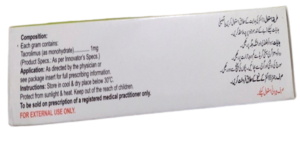
Manufacturer & Buy Online:
Tacrus Ointment is manufactured by: Maxitech Pharma (Pvt) Ltd.
This is the link to the manufacturer: https://maxitechpharma
You can buy it online at: https://healthwire.pk
It is available online, or you can purchase it from any nearby pharmacy. It is currently (2026) available at the retail price of around 950 rupees.