
ENZ10
ENZ10 coenzyme Q10 50mg is 20 oral gelatin capsules. It supportive antioxidant for mitochondrial function. Coenzyme Q10 is a fat-soluble vitamin-like substance present in all of your cells. It earns its name” CoenzymeQ10″ as it is needed for several key enzymatic steps in the production of en energy within the cell. These enzymes are essential for the production of adenosine triphosphate (ATP), upon which all cellular functions depend. It has a broad range of functions in the human body, which are all very dependent on adequate levels of CoQ10. In fact, 95% of the body’s energy is said to come from this source.
However, when natural CoQ10 levels are inadequate, even the basic metabolic functions of these cells are impaired. Coenzyme Q10 is a naturally occurring compound that is synthesised endogenously in humans and is also found in some foods. Dietary sources are relatively low, with an estimated dietary intake of less than 10 mg a day from meat and poultry, and exogenous CoenzymeQ10 is needed by the human body.
The body’s production of CoQ10 can decrease due to deficiencies in essential vitamins and minerals required for its complex synthesis process. In addition, excessive physical activity or high metabolic demands can deplete CoQ10 levels, especially in the heart muscle, which requires large amounts of energy to function properly.
Package contains: Each ENZ10 package contains 20 capsules of 50mg in alu-alu packaging and a leaflet inside.
Composition: 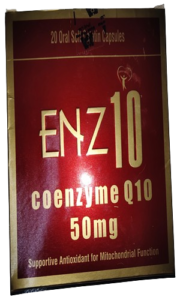
Each soft gelatin capsule contains: Coenzyme Q10 USP 50mg
Excipients: Gelatin, Glycerin, Sorbitol, Preservative and Colour
Mfg. Specs. USP
Dosage & Administration: 1 soft gelatin capsule twice daily or as advised by the physician.
As directed by the Physician. For detailed information, please see the insert. For oral use only.
Indications / Uses: Why do you need to take Coenzyme ENZ10 supplements?
Age-related depletion: Studies have shown that the body’s natural Co Q10 levels begin to drastically decease after the age of 21. Coincidentally, some have noted that during this time, our bodies first begin to show the negative signs.
Cholesterol-lowering drugs: Drugs (Statins) prescribed for lowering cholesterol usually interfere with the natural production of CoQ10. For this reason, doctors recommend a CoQ10 dosage to supplement the depleted natural levels.
Heart health supplement: Mitochondrial cells are most prevalent in the vital organs, like the heart, since they use the most energy. There have been a number of studies (including double-blind research) that suggest optimal CoQ10 dosage supports cardiovascular health.
Parkinson’s disease: It has been found that sufferers of this disease have abnormally low CoQ10 levels. An extensive study funded by the National Institute of Health, USA, concluded that CoQ10 dosage supplementation resulted in a “significant reduction “in disability symptoms experienced by early-stage sufferers.
Male infertility/ Fertility enhancement: There are several studies that showed that taking a CoQ10 supplement increases sperm count and motility. Taking CoQ10 increases the amount in the semen. It is believed that higher concentrations in the semen will improve sperm function, leading to increased fertility.
Dosage of Coenzyme ENZ10 is needed as a supplement:
Hypertension: Randomized, double-blind, placebo-controlled trial of Coenzyme Q10 in isolated systolic hypertension. (South Medical Journal 2001), We conducted a 3-month randomised, double-blind, placebo-controlled trial with twice daily administration of 100 mg of oral CoQ10 and determination of plasma levels before and after the treatment. The mean reduction in systolic blood pressure was 17 mm Hg. None of the patients exhibited orthostatic blood pressure changes.
Congestive heart failure: The recommended dosage is up to 100 mg CoQ10 per day for the first 2-3 weeks. Cholesterol-lowering drugs (Statins). Patients with high cholesterol levels who are put on statins such as Lipitor and Zocor should take additional CoQ10 200 mg daily for a few weeks during therapy to counteract the muscle damage from statin drugs.
Parkinson’s disease: Studies have used a wide range of Coenzyme Q10 doses, from as low as 300 mg per day to 1200 mg per day. Typically, high doses were used for conditions such as Parkinson’s disease or Mitochondrial diseases.
Migraine: Study of 42 patients who had suffered from migraine for a year or more, a dose of 100 mg daily decreased migraine attacks by 50%.
Depression: Long-term use of Tricyclic Anti-depressants is associated with depletion of CoQ10 & may increase the risk of heart problems. Simultaneous administration of CoQ10 200 mg daily prevents side effects associated with antidepressants.
Male Infertility/Fertility enhancement: In a recent study at the Polytechnic University of Marche, Italy. 60 infertile men between the age of 27-39 years were given a daily dose of 300mg Coenzyme Q10 or placebo for 6 months of follow-up. CoQ10 increased significantly in both seminal plasma and semen cells the improved sperm motility.
P.I.H/Pre-eclampsia: In a recent study, Coenzyme Q10 supplementation 200 mg daily starting from 20 weeks of pregnancy till delivery appears to be 95% safe, well tolerated & effective, which resulted in a significant reduction in the risk of pre-eclampsia and birth defects.
Skin/Cutaneous antioxidant & energizer: Recent studies showed that cytokine production in keratinocytes is inhibited by Coenzyme Q10, resulting in a decrease of metalloproteinase, leading to wrinkle reductions. CoQ10 was also able to significantly suppress the expression of collagenase in human dermal fibroblasts following UVA radiation. These results indicate that CoQ10 has the efficacy to prevent many of the detrimental effects of photoaging. Coenzyme Q10 supplementation of 100 mg daily helps lower age-related degeneration of the skin & photo aging.
Dosage: For adults 19 years and older: The recommended dose of Coenzyme Q10 supplementation is 100-200 mg per day in divided doses. But the recommended amount can be as high as 1200 mg per day. Soft Gels tend to be better absorbed by the body as compared to hard shell capsules or other preparations.
Side Effects: Adverse effects are very rare after oral administration of Coenzyme Q10 less than 1%, if occurs the are transit, may include nausea, epigastric discomfort, diarrhea and skin rash.
Precautions: There have been reports that Coenzyme Q10 may decrease the effectiveness of blood-thinning medications such as warfarin or clopidogrel, leading to the need for increased doses.
Drug Interactions: Certain drugs can deplete Coenzyme Q10. These include,
- Cholesterol-lowering drugs such as Statins.
- Beta-blockers for High Blood Pressure.
- Tricyclic Anti-depressants Medications.
- Type 11 Diabetes Medications.
Excretion: Coenzyme Q10 is excreted predominantly via the biliary tract. Over 60% of oral doses are recovered the faeces. Its elimination half-life is approximately 34 hours.
Storage Instructions: Coenzyme Q10 store at room temperature. Protect from light, moisture and excessive heat. Keep out of the reach of children.
Note: Food Supplement: Not for the treatment of any disease.
Storage Conditions & Instructions: Protect from sunlight. Store at cool and dry place below 25°C. Keep away from the reach of children. For detailed information, consult your physician. 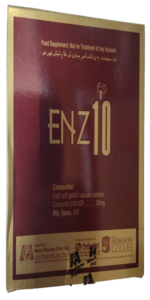
Manufacturer & buy online:
ENZ10 capsules are manufactured in Collaboration with Pharma Tech. (A part of HONSON PharmaTech Group Canada).
This is the link to the manufacturer: https://pharmatec
It is imported by: Mass Pharma (PVT) LTD.
This is the link to the imported company: https://masspharma
You can buy it online at: https://healthwire.pk
Or you can purchase it from any nearby pharmacy. It is currently (2026) available at the retail price of around 1138 rupees.