
Sonnet Injection
Sonnet by Saffron 250 mg Injection (POM) is Ceftriaxone Sodium U.S.P. for I.M. (Intramuscular) use only (U.S.P. Specs.), containing 1 vial with 250 mg Ceftriaxone Sodium + 1 ampoule with 2 ml lignocaine IM. Ceftriaxone Sodium is a broad-spectrum, third-generation cephalosporin antibiotic used to treat various bacterial infections.
Package Contains: Each Sonnet package contains 250 mg / 2 ml of 1 ampoule & a leaflet.
Single dose vial / Composition: Each combination pack contains:
Vial: Each vial contains: 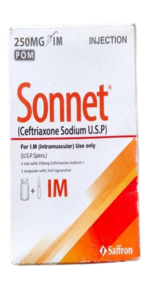
Ceftriaxone Sodium U.S.P equivalent to
Ceftriaxone 250 mg
Product complies with U.S.P. Specs.
Lignocaine Ampoule: Each 2 ml contains:
Lidocaine HCL U.S.P 250 mg
Product complies with USP specs.
Dosage: As directed by the Physician.
Injection Preparation: Dissolve vial contents by vigorous shaking using 2 ml lignocaine (Lidocaine HCL U.S.P 1%) injection provided with the pack. Use immediately after reconstitution. Discard unused portions.
Indications / Uses: Sonnet Injection is indicated for the following:
- Lower Respiratory Tract Infections caused by Streptococcus pneumoniae, Staphylococcus aureus, Haemophilus influenza, Haemophilus parainfluenzae, or Serratia
- Acute Bacterial Otitis Media caused by Streptococcus pneumoniae, Haemophilus influenza or Moraxilla catarrhalis.
- Skin and Skin Structure infections caused by Staphylococcus aureus, staphylococcus epididymitis, streptococcus pyogenes, bacteroides fragillis, Peptostreptococcus
- Urinary Tract Infections caused by Escherichia coli, Proteus mirabillis, Proteus vulgaris, Morganella morganii, or Klebsiella pneumoniae.
- Bone and Joint Infections caused by Staphylococcus aureus, Streptococcus pneumoniae, Escherichia coli, Proteus mirabilis, Klebsiella pneumoniae or Enterobacter
Dosage & Administration:
- Administration: Ceftriaxone may be administered intravenously or
- Method of administration: As a general rule, the solutions should be used immediately after reconstitution. Solutions retain their physical and chemical stability for 6 hours at room temperature; the solution ranges in color from pale yellow to amber, depending on the concentration and length of storage.
- Dosage: Ceftriaxone may be administered by deep intramuscular injection and slow intravenous injection after reconstitution of the solution according to the directions. Dosage and mode of administration should be determined by the severity of the infection and the patient’s condition.
- Standard dosage: Standard dosage for adults and children ( 12 years and over ) is 1g once daily. In severe cases or in infections caused by moderately sensitive organisms, the dosage may be raised to 40 g once daily.
Use In Special Populations:
- Pregnancy: Ceftriaxone crosses the placenta. Safety in human pregnancy has not been established. Reproductive studies in animals have shown no evidence of embryo toxicity.
- Nursing Mothers: Low concentration of Ceftriaxone is excreted in human milk. Caution should be exercised when Ceftriaxone is administered to a nursing woman or as directed by the Physician.
Contraindications: Ceftriaxone is contraindicated in patients with known allergy to the cephalosporin class of antibiotics.
Adverse Effects: Ceftriaxone is generally well tolerated; the most common adverse reactions associated with Ceftriaxone are changes in white blood cell counts, local reactions at Site of administration, rash and diarrhea.
Like all medicines, this medicine can cause side effects, although not everybody gets them.
The following side effects may happen with Ceftriaxone:
- Incidence of adverse effects greater than 1%:
- Eosinophilia (6%)
- Thrombocytosis (5.1%)
- Elevations in liver enzymes (3.1-3.3%)
- Diarrhea (2.7%).
- Leukopenia (2.1%)
- Elevation in BUN (1.2%)
- Local reactions – pain, tenderness, irritation (1%) Rash (1.7%).
Warnings & Precautions:
- As with other cephalosporins, anaphylactic shock cannot be ruled out even if a thorough patient history is taken. Pseudomembranous colitis has been reported with nearly all antibacterial agents, including Therefore, it is important to consider this diagnosis in patients who present with diarrhea subsequent to the administration of antibacterial agents.
- Superinfections with non-susceptible microorganisms may occur as with other antibacterial agents. Shadows, which have been mistaken for gallstones, have been detected on sonograms of the gallbladder, usually following doses higher than the standard recommended dose. These shadows are, however, precipitated, of calcium-Ceftriaxone which disappears on completion or discontinuation of Ceftriaxone therapy.
- Rarely have these findings been associated with symptoms. In symptomatic cases, conservative non-surgical management is recommended. Discontinuation of Ceftriaxone treatment in symptomatic cases should be at the discretion of the physician.
- Ceftriaxone must not be mixed or administered simultaneously with calcium-containing solutions or products, even via different infusion lines. Calcium-containing solutions or products must not be administered within 48 hours of last administration of
- Cases of fatal reactions with calcium-Ceftriaxone precipitates in lung and kidneys in neonates and premature has been described. In some cases the infusion lines of administration of Ceftriaxone and calcium-containing solutions differed. Cases of pancreatitis, possibly of biliary obstruction aetiology, have been rarely reported in patients treated with Ceftriaxone.
- Most patients presented with risk factors for biliary stasis and biliary sludge, e.g., preceding major therapy, severe illness and total parenteral nutrition. A trigger or cofactor role of ceftriaxone-related biliary precipitation can not be ruled out. Safety and effectiveness of Ceftriaxone in neonates, infants and children have been established for the dosages described under dosage and administration.
- Studies have shown that ceftriaxone, like some other cephalosporins, can displace bilirubin from serum albumin. Therefore caution should be exercised when considering Ceftriaxone treatment in hyperbilirubinemic Ceftriaxone should not be used in neonates (especially premature) at risk of developing bilirubin encephalopathy. During prolonged treatment, the blood should be checked at regular intervals.
- As with other cephalosporins, anaphylactic reactions with fatal outcomes have been reported, even if a patient is not known to be allergic or previously exposed.
Instructions: 
Store at or below 25°C.
Protect from light after reconstitution. Keep out of the reach of children.
Note: To be sold on the prescription of a registered medical practitioner only.
Manufacturer & Buy Online:
Sonnet Injection is manufactured by: Saffron Pharmaceuticals ( Pvt. ) Ltd.
This is the link to the manufacturer: https://www.saffronpharma.com
You can buy it online at: https://ailaaj.com
Or you can purchase it from any nearby pharmacy. It is currently (2026) available at the retail price of around 108 rupees.
By: Munee