CipVal
CipVal (Ciprofloxacin) by GlaxoSmithKline (Value Health) contains 10 tablets of 500 mg. It is used for urinary tract infections, genital tract infections, and pelvic inflammatory disease. Warning: See the package insert.
Package Contains: Each CipVal package contains 10 tablets of 500mg & a leaflet.
Composition: Each tablet contains: 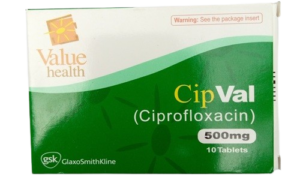
Ciprofloxacin (as Hydrochloride) U.S.P. 500mg
U.S.P. Specifications
Dosage & Administration: To be used as directed by physician.
For details, see information leaflet. For oral use only.
Indications: CipVal is indicated for the following:
- Adults: Urinary tract infections, Genital tract infections (gonococcal urethritis and cervicitis due to susceptible Neisseria gonorrhoeae, epididymo-orchitis including cases due to susceptible Neisseria gonorrhoeae, pelvic inflammatory disease including cases due to susceptible Neisseria gonorrhoeae), infections of the gastro-intestinal tract (e.g. infectious diarrhoea), intra-abdominal infections, infections of the skin and soft tissue caused by Gram-negative bacteria, infections of the bones and joints, prophylaxis of invasive infections due to Neisseria meningitidis, inhalation anthrax (post-exposure prophylaxis and curative treatment). Ciprofloxacin may be used in the management of neutropenic patients with fever that is suspected to be due to a bacterial infection.
- Children and adolescents: Broncho-pulmonary infections in cystic fibrosis caused by Pseudomonas aeruginosa, complicated urinary tract infections and pyelonephritis, inhalation anthrax (post-exposure prophylaxis and curative treatment). Ciprofloxacin may also be used to treat severe infections in children and adolescents when this is considered to be necessary. Treatment should be initiated only by physicians who are experienced in the treatment of cystic fibrosis and/or severe infections in children and adolescents.
Adverse Reactions:
- Infections and Infestations: Uncommon: mycotic superinfections.
- Blood and Lymphatic System Disorders: Uncommon: eosinophilia; Rare: leukopenia, anaemia, neutropenia, leukocytosis, thrombocytopenia, thrombocythaemia; Very rare: haemolytic anaemia, agranulocytosis, pancytopenia (life-threatening), bone marrow depression (life-threatening).
- Immune System Disorders: Rare: allergic reaction, allergic oedema/angioedema; Very rare: anaphylactic reaction, anaphylactic shock (life-threatening), serum sickness-like reaction.
- Metabolism and Nutrition Disorders: Uncommon: decreased appetite; Rare: hyperglycaemia, hypoglycaemia.
- Psychiatric Disorders: Uncommon: psychomotor hyperactivity/agitation; Rare: confusion and disorientation, anxiety reaction, abnormal dreams, depression, hallucinations; Very rare: psychotic reactions; Not known: mania, including hypomania.
- Nervous System Disorders: Uncommon: headache, dizziness, sleep disorders, taste disorders; Rare: paraesthesia, dysaesthesia, hypoesthesia, tremor, seizures, including status epilepticus, vertigo; Very rare: migraine, disturbed coordination, gait disturbance, olfactory nerve disorders, intracranial hypertension, pseudotumor cerebri; Not known: peripheral neuropathy and polyneuropathy.
- Eye Disorders: Rare: visual disturbances (e.g. diplopia); Very rare: visual colour distortions.
- Ear and Labyrinth Disorders: Rare: tinnitus, hearing loss/hearing impaired.
- Cardiac Disorders: Rare: tachycardia; Not known: ventricular arrhythmia and torsades de pointes, ECG QT prolonged.
- Vascular Disorders: Rare: vasodilatation, hypotension, syncope; Very rare: vasculitis.
- Respiratory, Thoracic and Mediastinal Disorders: Rare: dyspnoea (including asthmatic condition).
- Gastrointestinal Disorders: Common: nausea and diarrhea; Uncommon: vomiting, gastrointestinal and abdominal pains, dyspepsia, flatulence; Rare: antibiotic-associated colitis; Very rare: pancreatitis.
- Hepatobiliary Disorders: Uncommon: increase in transaminases, increased bilirubin; Rare: hepatic impairment, cholestatic icterus, hepatitis; Very rare: liver necrosis.
- Skin and Subcutaneous Tissue Disorders: Uncommon: rash, pruritus, urticaria; Rare: photosensitivity reactions; Very rare: petechiae, erythema multiforme, erythema nodosum, Stevens-Johnson syndrome, toxic epidermal necrolysis; Not known: acute generalised exanthematous pustulosis (AGEP), drug reaction with eosinophilia and systemic symptoms (DRESS).
- Musculoskeletal and Connective Tissue Disorders: Uncommon: musculoskeletal pain, back pain, chest pain, arthralgia; Rare: myalgia, arthritis, increased muscle tone and cramping; Very rare: muscular weakness, tendinitis, tendon rupture (predominantly Achilles tendon), exacerbation of symptoms of myasthenia gravis.
- Renal and Urinary Disorders: Uncommon: renal impairment; Rare: renal failure, haematuria, crystalluria, tubulointerstitial nephritis.
- General Disorders and Administration Site Conditions: Uncommon: asthenia, fever; Rare: oedema, sweating (hyperhidrosis).
- Investigations: Uncommon: increase in blood alkaline phosphatase; Rare: increased amylase; Not known: International normalised ratio increased (in patients treated with vitamin K antagonists).
- Paediatric patients: In children, arthropathy (arthralgia, arthritis) is reported to occur commonly.
Contraindications: Hypersensitivity to the active substance, to other quinolones or to any of the excipients, concomitant administration of ciprofloxacin and tizanidine. 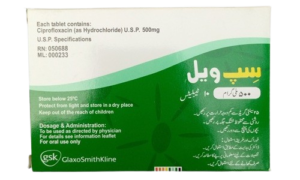
Instruction:
Store below 25°C.
Protect from light and store in a dry place.
Keep out of the reach of children.
Note: Trade marks are owned by or licensed to the GSK group of companies.
Manufacturer & Buy Online:
CipVal tablets are manufactured by: GlaxoSmithKline Pakistan Limited.
This is the link to the manufacturer: https://pk.gsk
You can buy it online at: https://www.dvago.pk
You can buy it from any nearby pharmacy. It is currently (2026) available at the retail price of around 430 rupees.
By: Urooj