Vomistop
Vomistop (Domperidone Maleate BP) (BP Specs) by Danas is 50 tablets of 10 mg. It is used to treat nausea, vomiting, and digestive issues like gastroparesis.
Package Contains: Each pack of Vomistop contains 50 tablets and a leaf inserted inside.
Composition: 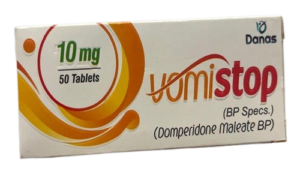
Each tablet contains:
Domperidone Maleate BP eq. to Domperidone 10mg
(BP Specs.)
Indications: The dyspeptic symptom complex that is often associated with delayed gastric emptying, gastro-oesophageal reflux and oesophagitis. Epigastric sense of fullness, early satiety, feeling of abdominal distension, upper abdominal pain.
Bloating, eructation, flatulence. Nausea and vomiting, Heartburn with or without regurgitation of gastric contents in the mouth. Nausea and vomiting of functional, organic, infectious or dietetic origin or induced by radiotherapy or drug therapy. A specific indication is nausea and vomiting induced by dopamine agonists as used in Parkinson’s disease (such as L-dopa and bromocriptine).
Dosage & Administration:
1. Chronic dyspepsia (mainly oral administration)
Adults:1 tablet, 3 times daily, 15-30 minutes before meals.
Children 5-10 years of age: 1/2 tablet, 3 times daily before meals and if necessary once more in the evening.
2. Acute and subacute conditions (particularly nausea and vomiting)
Adults: 2 tablets, 3-4 times daily before meals and before bedtime
Children 3 to 12 years of age: 1 tablet, 3-4 times daily before meals and before bedtime.
Or as directed by the physician.
Contraindications: Vomistop is contraindicated in patients with known intolerance to the drug. Vomistop should not be used whenever stimulation of gastric motility might be dangerous, e.g. in the presence of gastro-intestinal haemorrhage, mechanical obstruction or perforation. Vomistop is also contraindicated in patients with a prolactin-releasing pituitary tumor (prolactinoma).
Warning And Precautions:
- Use in Infants: Because the metabolic and blood-brain barrier functions are not fully developed during the first months of life, any drug should only be given to infants with great caution and under close medical supervision.
- Use in liver disorder: Since domperidone is highly metabolized in the liver, Vomistop should be used with caution in patients with hepatic impairment
- Use in kidney disorder: In patients with severe renal insufficiency (serum creatinine > 6mg/100 Le> 0.6m mol/l), the elimination half-life of domperidone was increased from 7.4 to 20.8 hours, but plasma levels were lower than those in healthy volunteers. Since the unchanged drug is excreted via the kidney. It is unlikely that the dose of a single acute administration needs to be adjusted in patients with renal insufficiency. However, on repeated administration, the dosing frequency should be reduced to once or twice daily depending on the severity of the impairment, and the dose may need to be reduced. Generally, patients on prolonged therapy should be reviewed regularly.
Pregnancy And Lactation: Vomistop should only be used during the first trimester of pregnancy if this is justified by the anticipated therapeutic benefit. The drug is excreted in the breast milk; in women, domperidone concentrations in breast milk are 4 times lower than the corresponding plasma concentration. Therefore, nursing is not recommended for mothers who are taking Vomistop, unless the expected benefits outweigh any potential risk.
Adverse Reactions: Side effects are very rare; exceptionally, some transient cramps have been reported. Extrapyramidal phenomena are rare in young children and exceptional in adults. Vomistop may induce an increase in the plasma prolactin level. In rare cases this hyperprolactinaemia may give rise to neuroendocrinological phenomena such as galactorrhea and gynaecomastia. When the blood-brain barrier is immature (as in infants) or impaired, the possible occurrence of neurological side effects cannot be totally excluded. Rare allergic reactions such as rash and urticaria have also been reported.
Pharmacodynamics: Domperidone is a dopamine antagonist with anti-emetic properties similar to those of metoclopramide and certain neuroleptic drugs. Unlike these other drugs, however, domperidone does not readily cross the blood-brain barrier. In domperidone users, especially in adults, extrapyramidal side effects are very rare. Its antiemetic effects may be due to a combination of peripheral (gastrokinetic) effects and antagonism of dopamine receptors in the chemoreceptor trigger zone, which lies outside the blood-brain barrier in the area post trematic. Animal studies, together with the low concentrations found in the brain indicate a predominantly peripheral effects of domperidone on dopamine receptors. Studies in humans have shown oral domperidone to increase the duration of antral and duodenal contraction, to increase the gastric emptying of liquids and semi-solids in healthy subjects and of solids in patients in whom it was delayed, and to increase lower oesophageal sphincter pressure in healthy subjects; it has no effects on gastric secretion.
Pharmacokinetics: In fasting subjects, domperidone is rapidly absorbed after oral administration with peak plasma concentration at approximately 1 hour. The low absolute bioavailability of oral domperidone (approximately 15%) is due to an extensive first-pass.metabolism in the gut wall and liver. Although domperidone’s bioavallability is enhanced In normal subjects when taken after meal, patients with gastro-intestinal complaints should take domperidone 15-30 minutes before a meal, The time of peak absorption is stightly delayed and the AUC somewhat increased when the oral drug is taken after a meal. Oral domperidone does not appear to accumulate or to induce its own metabollsm a plasma level after 90 minutes of 21mg/ml after two weeks oral administration of 30mg per day was almost the same as that of 18mg/ml after the first dose. Domperidone is 91-93% bound to plasma proteins.
Overdosage: Symptoms of overdosage may include drowsiness, disorientation and extrapyramidal reactions, especially in children.
Treatment: In case of overdosage, the administration of activated charcoal and close observation of the patient are recommended. Anticholinergic, Anti-Parkinson’s drugs, or antihistamines with anticholinergic properties may be helpful in controlling the extrapyramidal reaction. 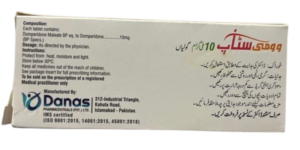
Instructions:
- Protect from heat, moisture and light.
- Store below 30℃.
- Keep all medicines out of the reach of children.
- See package insert for full prescribing information.
- To be sold on the prescription of a registered medical practitioner only.
Manufacturer & Buy Online:
Vomistop tablets are manufactured by Danas Pharmaceuticals (PVT.) LTD.
This is the link to the manufacturer: https://danaspharma.com
The tablets are currently not available online, but you can buy them from any nearby pharmacy. It is currently (2026) available at the retail price of around 288 rupees.
By: Maliha Gul