Nepac
Nepac (Nepafenac 0.1%) is a 5ml Sterile ophthalmic suspension. The eye drops suspension is a topical, non-steroidal anti-inflammatory (NSAID) prodrug for ophthalmic use. Nepafenac is designated chemically as 2-amino-3-Benzoylbenzeneacetamide with an empirical formula of CisHN20.
It reduces inflammation and pain in the eye. It becomes active only after it enters the eye and changes into Amfenac.
Package Contains: Each Nepac package contains 5ml eye drops in a dropper bottle & a leaflet.
Composition: 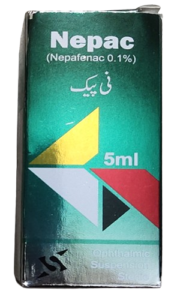
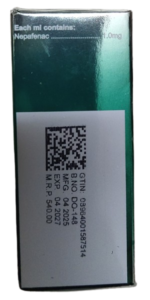
Each ml contains:
Nepafenac 1.0mg
Benzalkonium Chloride (as preservative)
Manufacturer’s Specs.
Dosage: As directed by the physician.
Indications / Uses: Nepac ophthalmic suspension is indicated for the treatment of pain and inflammation associated with cataract surgery.
Dosage & Administration: For Nepac Ophthalmic Suspension: One drop of Nepac Ophthalmic Suspension should be applied to the affected eye(s) three times daily beginning 1 day prior to cataract surgery, continued on the day of surgery and through the first 2 weeks of the postoperative period.
Nepac Ophthalmic Suspension may be administered in conjunction with other topical ophthalmic medications such as beta-blockers, carbonic anhydrase inhibitors, and alpha-agonists.
Contraindications: Hypersensitivity to the active substance or to any excipients of the product.
Pregnancy & Lactation: There are no adequate and well-controlled studies available. The drug should be used during pregnancy and lactation only if the potential benefit justifies the anticipated risk or as suggested by the treating physician.
Pediatric Use: The safety and effectiveness in pediatric patients below ten (10) years of age have not been established.
Geriatric Use: No overall differences in safety and effectiveness have been observed between elderly patients.
Precautions:
There is the potential for cross-sensitivity to acetylsalicylic acid, phenylacetic acid derivatives, and other non-steroidal anti-inflammatory agents. Therefore, caution should be used when treating individuals who have previously exhibited sensitivities to these drugs. With some non-steroidal anti-inflammatory drugs, including Nepafenac, there exists the potential for increased bleeding time due to interference with thrombocyte aggregation.
There have been reports that ocularly applied non-steroidal anti-inflammatory drugs may cause increased bleeding of ocular tissues (including hyphemas) in conjunction with ocular surgery. Topical non-steroidal anti-inflammatory drugs (NSAIDs), including Nepafenac, may slow or delay healing. Topical corticosteroids are also known to slow or delay healing. Concomitant use of topical NSAIDs and topical steroids may increase the potential for healing problems. Use of topical NSAIDs may result in keratitis. In some susceptible patients, continued use of topical NSAIDs may result in epithelial breakdown, corneal thinning, corneal erosion, corneal ulceration or corneal perforation.
These events may be sight-threatening. Patients with evidence of corneal epithelial breakdown should immediately discontinue use of topical NSAIDs, including Nepafenac, and should be closely monitored for corneal health. Post marketing experience with topical NSAIDs suggests that patients with complicated ocular surgeries, corneal denervation, corneal epithelial defects, diabetes mellitus, ocular surface diseases (e.g., dry eye syndrome), rheumatoid arthritis, or repeat ocular surgeries within a short period of time may be at increased risk for corneal adverse events, which may become sight-threatening.
Topical NSAIDs should be used with caution in these patients. Post-marketing experience with topical NSAIDs also suggests that using more than one day prior to surgery or use beyond 14 days post-surgery may increase patient risk for the occurrence and severity of corneal adverse events. It is recommended that Nepafenac be used with caution in patients with known bleeding tendencies or who are receiving other medications that may prolong bleeding time. The suspension should not be administered while wearing contact lenses.
Side Effects /Adverse Reaction: In controlled clinical studies, the most frequently reported ocular adverse events following cataract surgery were capsular opacity, decreased visual acuity, foreign body sensation, increased intraocular pressure, and sticky sensation.
These events occurred in approximately 5 to 10% of patients. Other ocular adverse events occurring at an incidence of approximately 1 to 5% included conjunctival edema, corneal edema, dry eye, lid margin crusting, ocular discomfort, ocular hyperemia, ocular pain, ocular pruritus, and photophobia, tearing and vitreous detachment. Some of these events may be the consequence of the cataract surgical procedure. Non-ocular adverse events reported at an incidence of 1 to 4% included headache, hypertension, nausea/vomiting, and sinusitis.
Cautions: To avoid contamination, never touch the dropper tip of the container to any surface. Replace the cap after using. FOR
 OPHTHALMIC USE ONLY.
Note /Instructions: For full prescribing Information see package insert. Store between 2-25°C. Protect from light. Keep out of the reach of children. Use within one month after opening. Shake well before.
Manufacturer & Buy Online:
Nepac eye drops are manufactured by: Sante (Private) Limited.
This is the link to the manufacturer: https://www.sante
You can buy it online at: https://www.dvago.pk
It is available online, or you can purchase it from any nearby pharmacy. It is currently (2026) available at the retail price of around 540 rupees.