Diovan
Diovan 80 (Valsartan) tablets are used for the treatment of hypertension. The medicine is used only as directed by a registered medical practitioner. It is an angiotensin II receptor blocker (ARB). It relaxes blood vessels by blocking a hormone (angiotensin II) that normally causes them to tighten. This makes it easier for the heart to pump blood.
Package Contains: Each package of Diovan contains 28 tablets of 80 mg and an enclosed informational leaflet. It is also available in 40 mg, 160 mg & 320 mg strengths.
Composition: 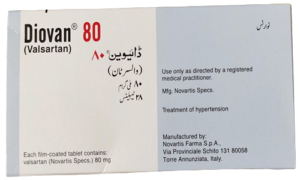
Each film-coated tablet contains:
Valsartan (Novartis Specs.) 80 mg.
Mfg. Novartis Specs.
Indications / Uses: It is indicated for Hypertension: Treatment of hypertension.
Heart failure: Treatment of heart failure (NYHA class W-IV) in adult patients receiving standard therapy such as diuretics, digitalis and either angiotensin-converting enzyme (ACE) inhibitors or beta-blockers but not both, presence of all these standard therapies is not mandatory.
Diovan improves morbidity in these patients, primarily via reduction in hospitalization for heart failure. It also slows the progression of heart failure, improves NYHA functional class, ejection fraction and signs and symptoms of heart failure and improves quality of life versus placebo.
Post-myocardial infarction: Diovan is indicated to improve survival following myocardial infarction in clinically stable adult patients with signs, symptoms or radiological evidence of left ventricular failure and/or with left ventricular systolic dysfunction.
Dosage regimen & Administration: It can be given with or without food and should be administered with water.
For adult population: Hypertension: The recommended dose of Diovan is 80 mg film-coated tablet once daily, irrespective of race, age, of gender. The antihypertensive effect is substantially present within 2 weeks, and maximal effects are seen after 4 weeks. It may also be administered with or without antihypertensive agents.
Heart failure: The recommended starting dose of Diovan is 40 mg film-coated tablet twice daily. Up-titration to 80 mg and 160 mg twice daily should be done to the highest dose tolerated by the patient. The maximum daily dose administered in clinical trials is 320 mg in divided doses. Evaluation of patients with heart failure should always include assessment of renal function.
Post-myocardial infarction: Therapy may be initiated as early as 12 hours after a myocardial infarction. After an initial dose of 20 mg twice daily, valsartan therapy should be titrated to 40 mg. 80 mg, and 160 mg film-coated tablet twice daily over the next few weeks. The starting dose is provided by the 40 mg divisible tablet.
The target maximum dose is 160 mg twice daily. In general, it is recommended that patients achieve a dose level of 80 mg twice daily by two weeks after treatment initiation and that the target maximum dose be achieved by three months, based on the patient’s tolerability to valsartan during titration. If symptomatic hypotension or renal dysfunction occurs, consideration should be given to a dosage reduction.
Valsartan may be used in patients treated with other post-myocardial infarction therapies, e.g. thrombolytic, acetylsalicylic acid, beta-blockers, or statins.
Evaluation of post-myocardial infarction patients should always include assessment of renal function.
NOTE for all indications: No dosage adjustment is required for patients with renal impairment or for patients with hepatic impairment of non-biliary origin and without cholestasis.
Use in Children and Adolescents: The safety and efficacy of Diovan have not been established in children and adolescents (below the age of 18 years).
CONTRAINDICATIONS: Known hypersensitivity to valsartan or any of the excipients of Diovan.
Concomitant use of angiotensin receptor antagonists (ARBs), including Diovan or angiotensin converting enzyme inhibitors (ACEls) with aliskiren in patients with Type 2 diabetes.
Warnings & Precautions: Patients with the following conditions should use it with caution:
Patients with sodium and/or volume depletion, renal artery stenosis, impaired renal function, hepatic impairment & angioedema. For detailed information, read the leaflet or ask your doctor/pharmacist.
Adverse Drug Reactions: Adverse reactions are ranked by frequency. Within each frequency grouping adverse reactions are ranked in order of decreasing seriousness.
Hypertension: Adverse drug reactions in Hypertension
- Blood and lymphatic system disorders (Not known): Haemoglobin decreased hematocrit decreased, neutropenia, and thrombocytopenia.
- Immune system disorders (Not known): Hypersensitivity, including serum sickness.
- Metabolism and nutrition disorders (Not known): Blood potassium increased.
- Ear and labyrinth system disorders (Uncommon): Vertigo.
- Vascular disorders (Not known): Vasculitis.
- Respiratory, thoracic, and mediastinal disorders (Uncommon): Cough.
- Gastrointestinal disorders (Uncommon): Abdominal pain.
- Hepato-biliary disorders (Not known): Liver function test abnormal, including blood bilirubin increase.
- Skin and subcutaneous tissue disorders (Not known): Angioedema, dermatitis bullous, rash, pruritus.
- Musculoskeletal and connective tissue disorders (Not known): Myalgia.
- Renal and urinary disorders (Not known): Renal failure and impairment, blood creatinine increased.
- General disorders and administration site conditions (Uncommon): Fatigue.
The following events have also been observed during clinical trials in hypertensive patients irrespective of their causal association with the study drug: Arthralgia, asthenia, back pain, diarrhoea, dizziness, headache, insomnia, libido decrease, nausea, edema, pharyngitis, rhinitis, sinusitis, upper respiratory tract infection, viral infections.
Adverse reactions in heart failure and/or post-myocardial infarction:
- Blood and lymphatic system disorders (Not known): Thrombocytopenia.
- Immune system disorders (Not known): Hypersensitivity, including serum sickness.
- Metabolism and nutrition disorders (Uncommon): Hyperkalaemia.
- Nervous system disorders (Common): Dizziness, postural dizziness, (Uncommon): Syncope, headache.
- Ear and labyrinth system disorders (Uncommon): Vertigo.
- Cardiac disorders (Uncommon): Cardiac failure.
- Vascular disorders (Common): Hypotension, orthostatic hypotension, (Not known) Vasculitis.
- Respiratory, thoracic, and mediastinal disorders (uncommon): Cough.
- Gastrointestinal disorders (uncommon): Nausea, diarrhoea.
- Hepato-biliary disorders (Not known): Liver function test abnormal.
- Skin and subcutaneous tissue disorders (Uncommon): Angioedema, (Not known): Dermatitis bullous, rash, pruritus.
- Musculoskeletal and connective tissue disorders (Not known): Myalgia.
- Renal and urinary disorders (Common): Renal failure and impairment, (Uncommon) Acute renal failure, blood creatinine increased, (Not known) Blood urea increased.
- General disorders and administration site conditions (Uncommon): Asthenia, fatigue.
Blood potassium increased (frequency unknown)-reported in post-market reporting.
The following events have also been observed during clinical trials in patients with heart failure and/or post-myocardial infarction, irrespective of their causal association with the study drug: Arthralgia, abdominal pain, back pain, insomnia, libido decrease, neutropenia, edema, pharyngitis, rhinitis, sinusitis, upper respiratory tract infection, and viral infections.
Interactions:
- Dual blockade of the Renin-Angiotensin-System (RAS) with ARBs, ACEIs, or aliskiren.
- Potassium.
- Non-Steroidal Anti-Inflammatory Agents (NSAIDs), including Selective Cyclooxygenase-2 Inhibitors (COX-2 inhibitors).
- Lithium.
- Transporters.
For detailed information, read the leaflet or ask your doctor/pharmacist.
Pregnancy, Lactation, Females & Males of Reproductive Potential:
Pregnancy (Risk summary): As for any drug that acts directly on the RAAS, Diovan must not be used during pregnancy.
Due to the mechanism of action of II antagonists, a risk for the fetus cannot be excluded. In utero exposure to ACE inhibitors (a specific class of drugs acting on the RAAS) during the second and third trimesters has been reported to cause injury and death to the developing fetus. In addition, in retrospective data, first-trimester use of ACE inhibitors has been associated with a potential risk of birth defects. There have been reports of spontaneous abortion, aligohydramnios and ne renal dysfunction when pregnant women have inadvertently taken Valsartan.
If pregnancy is detected during therapy. Diovan should be discontinued as soon as possible.
Lactation: (Risk summary): It is not known whether valsartan is transferred into human milk. Since valsartan was transferred into the milk of lactating rats, it is not advisable to use Diovan in breastfeeding mothers.
Infertility: There is no information on the effects of Diovan on human fertility. Studies in rats did not show any effects of valsartan on fertility.
Instructions: For oral use. Do not store above 30°C, protect from moisture. Keep out of the reach and sight of children. For further information please read the enclosed leaflet. To be sold on the prescription of a registered medical practitioner only. 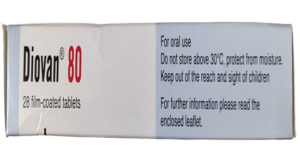
Manufacturer & Buy Online:
Diovan 80 tablets are manufactured by Novartis Pharma S.p.A., Italy.
This is the link to the manufacturer: https://www.novartis
The Sole Agent of the medicine is: Novartis Pharma (Pakistan) Limited.
You can buy this medicine online at: https://onehealth.pk